
How Tilawah Online Academy Teaches Faith with Clarity is not a decorative topic; it is a practical learning need for Muslim families who want children to grow with knowledge, confidence, and beautiful manners.
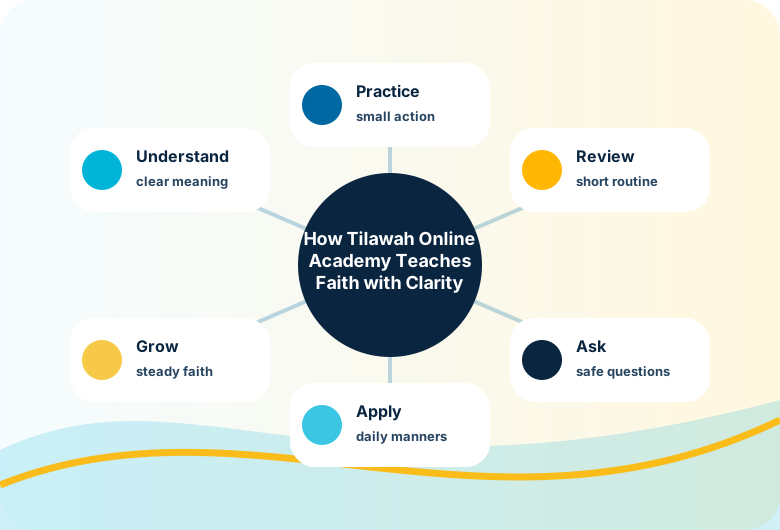
At Tilawah Online Academy, this subject is treated as part of a complete online learning journey: the child listens, asks, practices, reflects, and gradually connects the lesson with real life.
The focus of this guide is the academy method for explaining faith, identity, and worship to children. It avoids vague advice and gives parents a clear way to support the student before, during, and after class.
When children learn Aqidah with calm explanation, they do not only memorize information; they learn how to think, how to behave, and how to belong to their Muslim identity.

A useful lesson begins with respect for the student level. Some children need stories, some need examples, and some need a short repeated routine until the meaning becomes stable.
Families in the West often need structured help because the child may hear English or French all day while Islamic terms, Arabic words, and mosque culture appear only at certain times.
This is why a live online class should not be random. It should include a clear objective, teacher modeling, guided practice, gentle correction, and a home task that parents understand.
Learning objective
- Explain the main idea in simple language before asking the child to memorize details.
- Connect the idea with a daily situation so the learner sees why it matters.
- Use one key term, such as Iman, and return to it during the lesson.
- Ask the child to repeat the meaning in their own words, not only copy the teacher.
- End the objective with one action that can be practiced at home.
Teacher method
- The teacher starts with a warm question that reveals the child’s current understanding.
- The explanation is short, accurate, and appropriate for age and language level.
- The teacher uses examples from family, school, mosque, and online learning life.
- Mistakes are corrected with dignity so the child stays confident and willing to try.
- The lesson closes with a summary that parents can easily follow.
Parent role
- Parents should prepare the learning place before class: device, notebook, water, and quiet space.
- After class, parents can ask one question: “What did you learn today that you can use?”
- Parents should praise effort before results because effort is what builds stable habits.
- A short review is better than a long lecture; consistency protects the child from boredom.
- When the lesson includes values, parents should model the value gently in the same week.
Student practice
- The student writes three words that summarize the lesson.
- The student gives one example from home or school.
- The student explains the idea to a parent or sibling in two minutes.
- The student chooses one behavior to practice until the next lesson.
- The student returns to the teacher with a question, observation, or short reflection.
Online academy application
- In an online class, visual structure matters: slides, short notes, and recap boxes keep attention alive.
- Tilawah Online Academy can connect the topic with Quran, Arabic vocabulary, Islamic Studies, and character education.
- The teacher should not rush to finish content; understanding is more important than page count.
- Parents need clear follow-up notes so the home routine supports the teacher’s plan.
- The best online lesson feels personal, caring, and academically organized at the same time.
Common mistakes to avoid
- Do not turn every Islamic topic into a warning; children also need love, beauty, and hope.
- Do not overload the child with difficult terms before the concept is clear.
- Do not compare siblings or classmates, because comparison often kills motivation.
- Do not treat online learning as a passive video; the child must speak, answer, and apply.
- Do not leave parents without a simple review task.
Helpful questions
- What does this lesson teach me about Allah, worship, manners, or responsibility?
- Which word in the lesson should I remember and use correctly?
- What mistake might a child make when understanding this topic?
- How can I practice this value tomorrow at home or at school?
- What question should I ask my teacher in the next class?
Academic learning benefit
- This style develops comprehension, not only memory.
- It trains children to organize ideas and speak about their faith clearly.
- It makes religious learning measurable through notes, examples, and weekly tasks.
- It supports bilingual learners who need English explanations with selected Arabic terms.
- It helps parents see progress beyond recitation or page numbers.
Spiritual benefit
- The child begins to feel that Islam is a lived path, not only a subject on a timetable.
- The lesson becomes connected to mercy, sincerity, discipline, and gratitude.
- Repeated practice helps the student move from knowing the value to loving it.
- This protects the child from seeing religion as pressure or performance only.
- A stable learning routine can become part of the family’s spiritual culture.
Practical home task
- Choose one sentence from the lesson and place it in the child’s notebook.
- Review the sentence for three minutes on two different days.
- Ask the child to give one example without reading from the notebook.
- Connect the example with a family action such as prayer, kindness, reading, or responsibility.
- Send a short note to the teacher if the child struggled or showed strong understanding.
Assessment signs
- The child can define the main term in simple words.
- The child can give a realistic example without memorizing a script.
- The child can connect the topic to Quran, manners, worship, or identity.
- The child asks a better question than before.
- The child shows one small behavior change during the week.
Final guidance
- Keep the lesson short enough to be repeated and deep enough to be remembered.
- Use stories only when they serve understanding and character, not entertainment alone.
- Make the child feel safe when asking about faith, worship, and Muslim identity.
- Let the teacher handle complex details gradually according to age and readiness.
- Build a bridge between the online class and the family’s real life.
Want a structured lesson for your child?
Tilawah Online Academy can turn this topic into a calm live class with review, questions, and practical homework for the family.
Book Free Trial on WhatsApp